

Honest Home Loan Interest Rates Comparison: Fixed vs Floating Explained
A real-world guide to comparing home loan interest rates. Stop losing money and understand exactly how fixed and floating EMIs work before you sign.
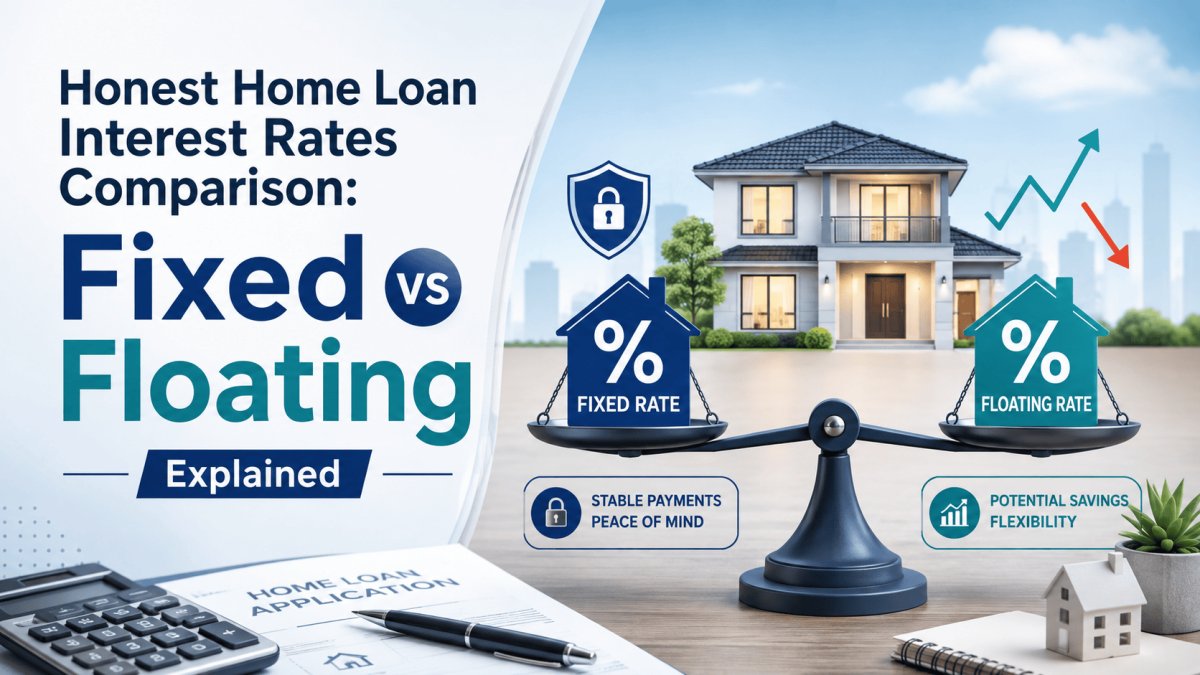
The Truth About Home Loan Interest Rates: Which One Actually Saves You Money?
Taking out a mortgage is terrifying. Let's just be honest about it. You are essentially promising to give away a massive chunk of your monthly income for the next fifteen to twenty years. When I was buying my first flat, I sat in a stuffy bank office staring at a mountain of paperwork. The bank manager kept throwing numbers at me, and I just nodded along so I wouldn't look completely clueless.
That was a huge mistake. I quickly realized that blindly accepting the first offer means you leave serious money on the table. Even a tiny 0.5% difference in your rate can drain hundreds of thousands of rupees from your pocket over the life of the loan. You are paying for the house, sure, but you are also paying a small fortune just for the privilege of borrowing the bank's money.
That is exactly why doing a proper, aggressive home loan comparison is the most profitable hour you will ever spend. You need to know exactly what you are getting into before you sign that agreement. Let us talk about the biggest choice you have to make right out of the gate.
The Big Choice: Fixed Rates vs. Floating Rates
Every single lender will ask you how you want your interest calculated. They make it sound like a simple preference, kind of like picking the color of your car, but it completely changes how you pay off your massive debt over the next couple of decades.
1. Fixed Interest Rates: Paying for Peace of Mind
A fixed rate is exactly what it sounds like. Your EMI stays exactly the same from the very first month to the very last month. The bank takes on the risk of the market changing.
- The Good Part: You can actually plan your life. If your EMI is 45,000 rupees today, it will be 45,000 rupees ten years from now. You never have to wake up and check the financial news to see if your monthly household bills just went up.
- The Catch: Banks absolutely do not give away this safety for free. They charge a heavy premium for it. A fixed rate is almost always set 1% to 2% higher than what they offer for floating loans. Plus, if the economy tanks and general interest rates drop, you are still stuck paying your high fixed rate.
- A Real Scenario: My cousin locked in a fixed rate of 9% back in 2018 because she really wanted stability. When 2020 hit and rates crashed across the board, her friends were paying around 7%. She was stuck overpaying every single month because breaking a fixed contract involves nasty penalty fees.
2. Floating Interest Rates: Following the Market
Floating rates move up and down based on the broader economy. If the central bank changes its lending policies, your home loan rate changes right along with it.
- The Good Part: You get a significantly cheaper starting price. Because you are taking on the market risk instead of the bank, they offer you a lower initial rate. Over a 20-year span, most people end up saving money because rates naturally go through cycles, and long-term trends usually balance themselves out.
- The Catch: You have to live with a bit of unpredictability. When rates go up, banks usually don't increase your EMI amount directly—instead, they quietly add more months to your loan term. You might think you have 5 years left to pay, only to check your statement and realize it jumped to 7 years.
- A Real Scenario: I personally chose a floating rate at 7.2%. A year later, inflation spiked, and the bank emailed me saying my rate was now 8.1%. My monthly deduction stayed exactly the same, but my loan tenure stretched out by nearly two extra years. To fix this mess, I used my yearly work bonus to make a lump-sum principal payment, which brought my timeline right back to normal.
Look Past the Headline Rate
When you start talking to different sales agents, they will aggressively wave their lowest percentage number in your face. Ignore the flashing lights and dig into the actual contract.
First, you have to ask about the processing fee. A bank might offer you a 7.5% interest rate, but if they hit you with a massive non-refundable processing fee of 1% of the total loan amount upfront, it suddenly isn't a good deal anymore. A competitor offering 7.6% with absolutely zero processing fees might actually be much cheaper out of pocket.
Second, you must check the prepayment rules. Life changes rapidly. You might get a huge promotion, sell some stocks, or inherit money. You will want to dump that cash into your loan to get out of debt faster. By law, banks cannot charge you a penalty for paying off a floating rate loan early. But if you have a fixed rate? They absolutely will penalize you, sometimes charging 2% or 3% of the amount you are simply trying to pay back.
Don't rush the process. Open up a spreadsheet, talk to at least three different lenders, and read the fine print twice. Fighting for a slightly better deal today is going to save you years of financial stress tomorrow.

My main purpose in writing these posts is simply to help you. All the information shared here is carefully put together just to be useful for your daily needs. I always try my absolute best to provide the right guidance and support you as much as possible.









Comments (0)