

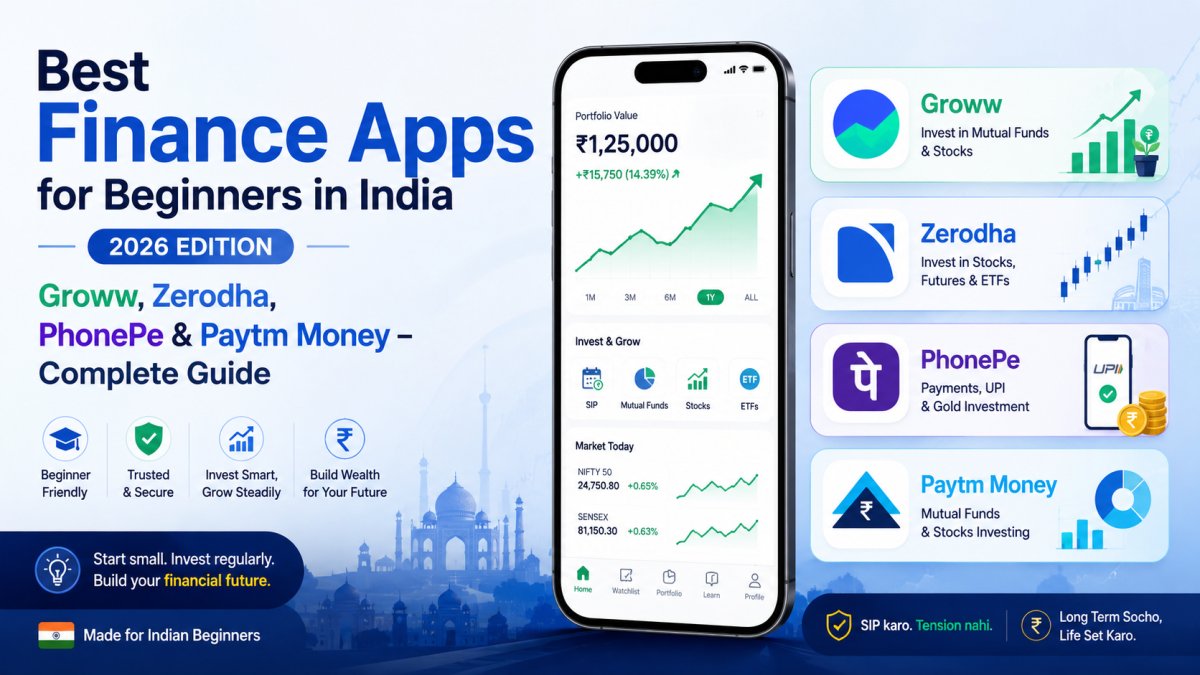
Best Finance Apps for Beginners in India (2026 Edition): Groww, Zerodha, PhonePe & Paytm Money – Complete Guide
Best Finance Apps for Beginners in India 2026: Groww, Zerodha, PhonePe aur Paytm Money guide.
When I placed my very first investment order years ago, I checked my bank account balance three times before hitting the "Buy" button. The fear was simple: what if I picked the wrong app and lost my hard-earned money? That hesitation is completely normal, and almost every beginner goes through it.
In 2026, finance apps are no longer just basic order placement tools. An app’s user interface, brokerage structure, mutual fund types, DP charges, customer support, and security setup directly shape your long-term wealth journey. A simple, clean app builds good financial discipline, whereas a crowded app full of fancy features might tempt you into unnecessary daily trading.
Real Investor Tip: The best app is not the one loaded with the most complex features. It is the one you can understand easily, use safely, and stay consistent with over many years.
Top 4 Finance Apps for Beginners in India (2026)
1. Groww: Best for Mutual Funds and Clean UI
Groww’s biggest selling point is its clutter-free design. Searching for mutual funds, starting a monthly SIP, tracking your portfolio, or buying basic stocks feels completely effortless for a first-timer. Groww offers Direct Mutual Funds with zero platform commission. There are no account opening fees or annual maintenance charges (AMC). For stock trades, brokerage is capped at ₹20 or 0.1% per executed order (whichever is lower, with a minimum charge of ₹5). Keep in mind that selling delivery shares will attract standard DP charges.
- Best For: First-time investors, SIPs, index funds, and simple portfolio tracking.
- Pros: Extremely clean interface, smooth onboarding process, direct mutual funds, and helpful fund comparison tools.
- Cons: Equity delivery is not free; frequent small stock purchases can accumulate minor brokerage charges over time.
- Experienced Advice: Do not blindly trust the "Popular Funds" tab on the homescreen. Always inspect a fund's expense ratio, risk level, underlying holdings, and 5-year track record yourself.
2. Zerodha Kite: Best for Serious Long-Term Equity Investors
Zerodha’s Kite platform offers a slightly more professional environment compared to Groww. It charges zero brokerage on long-term equity delivery investments, while intraday and F&O trades are charged at ₹20 or 0.03% (whichever is lower). Mutual funds are offered via their dedicated app, Coin, entirely commission-free. Accounts opened after mid-2026 enjoy a first-year AMC waiver for eligible individual accounts, while regular AMC applies in subsequent years based on BSDA limits or standard pricing (~₹300 + GST). DP charges stand at ₹15.34 per scrip upon selling.
- Best For: Long-term stock accumulation, ETFs, direct equity, and investors who want deeper financial education.
- Pros: Zero delivery brokerage, solid system stability, detailed tax reports, and free access to Varsity educational content.
- Cons: Kite (for stocks) and Coin (for mutual funds) operate as two separate apps, which can feel slightly disjointed for absolute beginners.
- Experienced Advice: Before placing your first stock order, spend an hour on Zerodha Varsity. It is 100% free, easy to read, and requires no paid subscription.
3. PhonePe Share.Market: Best for UPI-Friendly Convenience
Backed by the widely trusted PhonePe ecosystem, Share.Market allows you to invest in stocks, ETFs, IPOs, mutual funds, and curated WealthBaskets. Equity delivery and intraday transactions carry a brokerage fee of ₹20 or 0.1% (whichever is lower, minimum ₹2). Individual demat accounts currently feature zero listed AMC, while selling stock investments incurs an ₹18.50 DP charge per ISIN. UPI transfers integrate seamlessly without extra transfer friction.
- Best For: Regular PhonePe users who want seamless UPI integration and casual investing options.
- Pros: Familiar visual layout, zero listed AMC, and convenient access to stocks, ETFs, and themed baskets under one roof.
- Cons: Share.Market acts as a distributor for mutual fund products; always verify whether a scheme is labeled "Direct" or "Regular" before buying.
- Experienced Advice: Themed WealthBaskets look convenient, but always examine the basket's rebalancing frequency, underlying stock quality, and fee structure before committing capital.
4. Paytm Money: Feature-Rich, All-in-One Platform
Paytm Money combines direct mutual funds, stocks, IPOs, NPS (National Pension System), and advanced charting tools on a single platform. Modern pricing structures offer stock delivery, intraday, and F&O trades at a flat ₹20 per executed order. Standard account opening and ongoing AMC options remain very cost-effective (often ₹0 under current baseline plans), with overall DP selling charges around ₹20 including depository fees.
- Best For: Users looking to handle stocks, direct mutual funds, and pension funds (NPS) inside a single application.
- Pros: Broad spectrum of financial products, detailed market analytics, and fair flat-fee brokerage.
- Cons: The feature-dense dashboard can occasionally feel overwhelming if you simply want to set up one basic monthly SIP.
- Experienced Advice: Stay away from "Pay Later" or Margin Trading Facility (MTF) options when starting out. They rely on borrowed money, accumulate daily interest, and expose beginners to liquidation risk.
Finance Apps Comparison Table
| App Name | Best For | Account Charges | User Experience | Beginner Rating |
|---|---|---|---|---|
| Groww | Direct Mutual Funds & Simple UI | ₹0 Opening / ₹0 AMC | Very Easy & Clean | 4.7 / 5 |
| Zerodha | Direct Equity, ETFs & Education | Free Opening; Tiered/BSDA AMC rules | Professional & Precise | 4.5 / 5 |
| Share.Market | UPI Integration & Casual Portfolios | ₹0 Listed AMC; Transaction costs apply | Familiar & Intuitive | 4.1 / 5 |
| Paytm Money | Multi-Asset (MFs, Stocks, NPS) | ₹0 Opening/AMC on standard tier | Feature-Rich | 4.2 / 5 |
Note: Fee schedules are based on official broker tariffs in 2026. Separate statutory charges such as STT, GST, Exchange Transaction Fees, Stamp Duty, and Depository (DP) fees apply to market transactions. Always inspect the current tariff sheet inside your chosen app.
How to Start Safely: First-Timer Protocol
Step 1: Complete KYC Accurately
Keep your PAN card, mobile number, bank account details, and signature scan ready. Ensure that your name and date of birth match across your identification records. Always register a legal nominee and connect a bank account in your own name.
Step 2: Choose "Direct" Mutual Fund Plans
Mutual funds come in two formats: Direct and Regular. Both variants hold the exact same stocks, but Direct plans skip distributor commissions, resulting in a lower expense ratio and higher net returns over time. Always select scheme options containing the words "Direct - Growth".
Step 3: Begin with One Small SIP
Resist the urge to buy five different mutual funds on day one. Pick one broad-market Index Fund or well-diversified Flexi-Cap fund. Several platforms allow you to initiate a Systematic Investment Plan (SIP) starting at just ₹100 or ₹500 per month.
Step 4: Scale Up Gradually
Start with an amount you can easily afford every month without compromising your daily living expenses. Build a basic emergency cash buffer first, and then step up your SIP contributions by 5% to 10% whenever your income increases.
Security Guidelines Every Beginner Must Follow
- Enable Two-Factor Authentication (2FA): Biometric logins or app PINs are non-negotiable. Never share OTPs, passwords, or grant screen-sharing app permissions (like AnyDesk or TeamViewer) to anyone.
- Understand CDSL / NSDL Depositories: Your broker (Groww, Zerodha, etc.) is simply an interface. Your actual shares and demat assets are safely stored with government-regulated depositories (CDSL or NSDL).
- Use CDSL TPIN for Sales: When selling stock holdings, platforms require a secure TPIN authorization. This guarantees that stock debit orders originate directly from you.
- Audit Official Transaction Alerts: Always cross-verify the transaction confirmation emails and SMS messages sent directly by NSDL, CDSL, or stock exchanges (NSE/BSE).
- Beware of Telegram & WhatsApp Scams: Never send investment funds to private UPI IDs, self-proclaimed "account managers", or social media trading groups promising "guaranteed 100% monthly returns". SEBI frequently warns against unregistered stock tip channels.
Important Security Fact: SEBI registration means a platform adheres to financial regulations—it does NOT mean your investments are risk-free. Market fluctuation risk always remains with the investor.
Realistic Return Expectations (No False Promises)
A major mistake beginners make is expecting market investments to double overnight. Here are realistic, historical benchmark expectations for long-term planning:
- Broad Market Index Funds: ~10% to 12% annualized long-term growth expectations.
- Diversified Equity Mutual Funds: ~11% to 14% long-term historical CAGR range (subject to market cycles).
- Direct Individual Stocks: Variable. Good businesses create substantial wealth, but poor choices can lead to permanent capital loss.
- Fixed Deposits & Liquid Debt Funds: ~6% to 7% reasonable baseline for capital preservation.
Understanding CAGR vs. Smooth Returns: Compound Annual Growth Rate (CAGR) does not mean you earn the exact same percentage every single year. In reality, your portfolio might gain 22% in year one, drop by 8% in year two, and rise 14% in year three. CAGR simply reflects the smoothed-out annual rate over long time horizons.
Power of Compounding Example: If you invest ₹5,000 every month via an equity SIP for 15 years at an assumed average annual return of 12%, your total out-of-pocket investment will be ₹9,000,000. The estimated final portfolio value could reach approximately ₹25,000,000. Actual outcomes will vary based on market conditions and expense ratios, but the key driver is always time in the market.
Which App Should You Choose?
- If you want maximum simplicity for your first Mutual Fund SIP: Choose Groww.
- If you plan to buy individual stocks, ETFs, and study market fundamentals: Choose Zerodha.
- If you prefer a familiar payment ecosystem with casual stock features: Choose PhonePe Share.Market.
- If you want stocks, direct mutual funds, and NPS under one roof: Choose Paytm Money.
You do not need accounts across four different apps to build wealth. Select one secure platform that fits your primary goal, turn on two-factor authentication, set up a manageable monthly SIP, and let compounding do its work. Real financial growth comes from a consistent savings discipline—not from app-hopping or chasing daily speculative trading tips.

My main purpose in writing these posts is simply to help you. All the information shared here is carefully put together just to be useful for your daily needs. I always try my absolute best to provide the right guidance and support you as much as possible.











Comments (0)